
- Introduction
- What is Forex trading?
- Why Forex trading is better than other forms of trading?
- Common terminology in Forex trading
- Common mistakes beginners should avoid
- Is Forex trading legal in India?
- Conclusion
- FAQs
Introduction
The Forex market, also called the foreign exchange market, is one of the most active and largest liquidity financial markets. In this huge financial market, trading volumes stand well over $6 trillion every day. The forex market provides chances to trade the currencies for individuals willing to make some profits by just speculating on the movement of price. If you have basic capital and equally basic internet access, you can now easily have access to Forex trading through various online platforms.
But while it offers opportunities, it involves risks. This guide will walk you through how to start forex trading right from scratch, covering everything from the very basics and terminology involved to choosing a broker and managing risk.

What is Forex trading?
The process of forex involves the simultaneous purchase of one currency while selling another. Here, two currencies have been included in the system, i.e., in the equation, where the pair of the currency, i.e., EUR/USD, includes another currency, i.e., USD/INR. The currency that is bought in forex is called the base currency, whereas the currency sold in forex is called the secondary currency.
For instance,
• If EUR/USD = 1.1000, it means 1 Euro is equivalent to 1.10 US Dollars.
• If we believe that the Euro is going up relative to the Dollar, then we can buy.
• If you think it is going to weaken, then sell this pair.
The gain or loss will depend upon the effects of the value of the currency when you make a trade.
Why Forex trading is better than other forms of trading?
Forex trading attracts the attention of many beginners for a number of reasons:
• High liquidity – you can get in and out of trades easily.
• 24-hour market – Open five days a week, across global time zones.
• Low barrier to entry – You can start off with small capital.
• Leverage availability – Trade larger positions with limited funds.
• Profit in rising and falling markets – Buy or sell anytime.
That being said, leverage is a two-edged sword since it can increase profits and also losses, and education becomes important.
Common terminology in Forex trading
Prior to engaging in trade, it is essential to know the following key terms:
• Pip: Representing one percent in exchange rates, it is usually the smallest unit of exchange.
• Lot: The type of a trade, be it standard, mini, or micro.
• Leverage: Capital borrowed from others. This increases the size of the trades
• Margin: Amount needed to open a trade with leverage.
• Spread: Difference between the purchase price and the sale price.
• Stop Loss: The order is used to limit an investor’s losses.
• Take profit: An instruction to take the profits.
It is important to first grasp the basic elements, which will ensure confident trading and avoid costly blunders.
Common steps to start forex trading
Step 1: Learn how does the Forex market work
Multiple global factors can influence forex prices due to their impact on different currencies:
- Interest rates
- Economic indicators (GDP, inflation, employment)
- Central bank policies
- Geopolitical events
- Market sentiment
For Beginners, it is recommended that they should focus on trading highly popular currency pairs such as USD/EUR, EUR/GBP, USD/JPY as these currencies have good volume of trading and they provide stable signals whenever there is movement in these pairs.
Step 2: Choosing a reliable Forex broker
For starting forex trading you need to start from choosing a forex broker through which you will get access to forex market. Following features of a broker are necessary to count them as good forex broker:
- Transparent fee structure with low spreads
- A very fast order execution feature
- 24×7 customer support availability
- Good user experience on trading platform
- Availability of demo account
Step 3: Opening a Demo account
When you open a demo account, you are able to make paper trading where you use virtual/fake money to buy and sell forex. It helps you to get accustomed to the different parameters of forex trading such as speed and strategies.
Using a demo account gives following benefits:
- Generates a basic understanding how the platform works
- Helps in testing trading strategies in real world
- Understand how to place order in platform
- Generate emotional discipline for later period
Step 4: Gain knowledge about different Forex trading strategies
Forex trading has many strategies mostly based on smart money concepts. However, beginners should start from simple strategies such as below:
Trend Trading
Using moving averages to under the current market trend and making moves in the direction of trend.
Support and Resistance
Use support and resistance levels to make entry and exit out of market.
Breakout based trading
Use breakout from resistance level or support level to make market moves.
Scalping
Make quick trading where we square off trade in a very small time frame to gain a little profit, we make multiple scalping trades to gain good profit. However, it is recommended that scalping should be exercised only after gaining good understanding of market.
Beginners need to know that consistency matters over generating higher profits. Once consistency is obtained, profit can be increased in a disciplined manner.
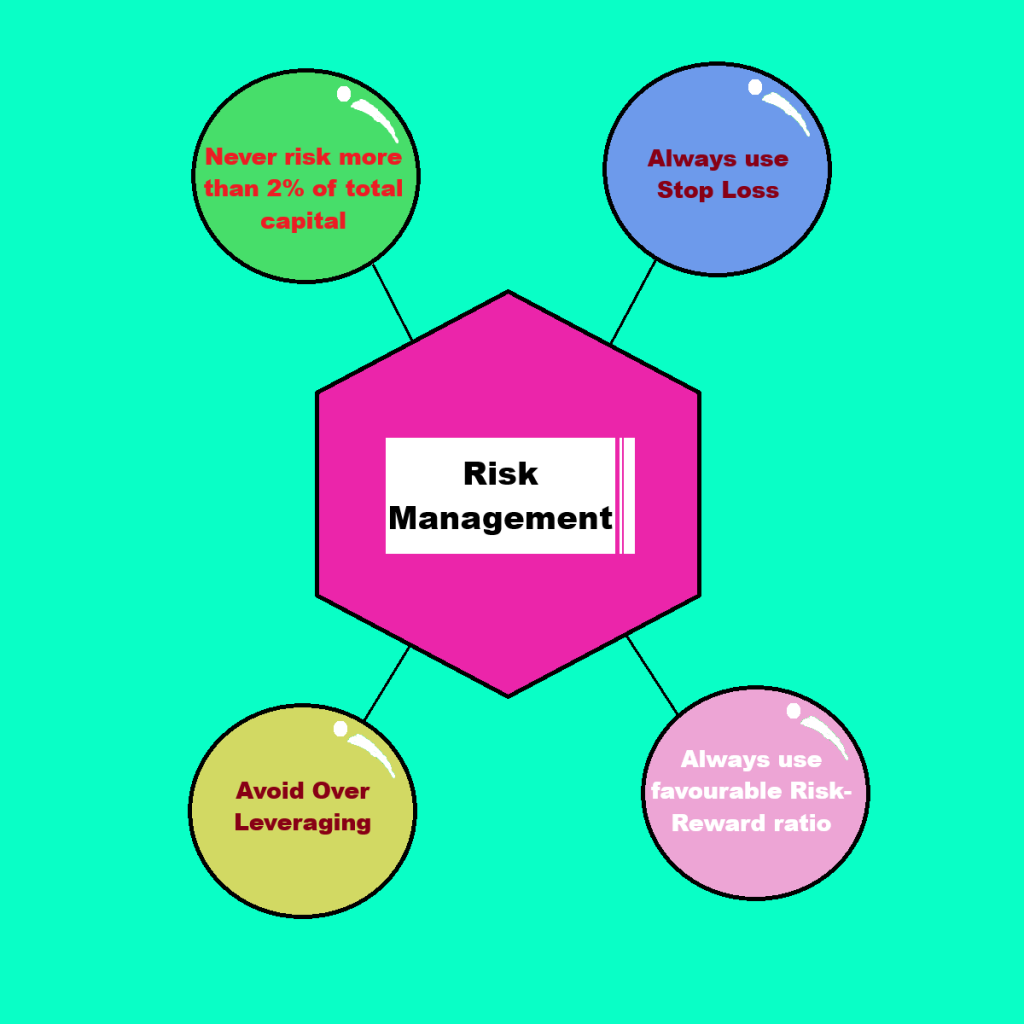
Step 5: Keeping Risk Management always in hindsight
Risk Management helps differentiate between traders and gamblers as gamblers do not think about risk while putting their money on bets.
Main features that every risk management strategy has are:
- Only risk around 1% to 2% of your total capital in a single trade.
- Never go after over-leveraging.
- Keep a stop loss in every trade, make it a rule.
- Always have a favourable risk to reward ratio so that every winning trade can compensate for losing trade.
Step 6: Start your live trading career with small capital
Once you are accustomed to demo trading, you should start live trading with a small capital. When you are involved in live trading, it brings the influence of different emotions such as greed and fear. It is required to keep check on such emotions and make following arrangements:
- Trade few pairs only.
- Try to avoid overtrading.
- Keep your strategy constant and stick to it.
- Keep a journal that has all details about your winning and losing trades.
A journal will help in identify your mistakes that lead to loss making trades. It also helps in creating new strategies from your mistakes.
Mistakes that beginners should avoid in Forex trading
Few mistakes that beginners should avoid in Forex trading are:
- Not having a proper risk management plan
- Getting influenced by emotions and indulge in overtrading
- Without making a plan before entering a trade
- Executing trades in a overleverage manner.
Whether Forex trading is legal in India?
Yes, trading in Forex is legal in India, with certain conditions. According to SEBI, individuals are allowed to trade only in currency pairs that consist of Indian Rupee (INR), such as USD/INR, GBP/INR, EUR/INR and JPY/INR. However, SEBI has banned spot forex trading and only allow forex derivatives for trade. SEBI allows trading forex derivatives at either of these exchanges:
- Bombay Stock Exchange
- National Stock Exchange
- Metropolitan Stock Exchange of India
Here is a list of SEBI authorised registered stock brokers in currency derivatives segments.
Conclusion
Forex trading is a very large field that needs a lot of understanding of global news, global demand and supply, technical patterns and relative fundamental issues. In addition, forex trading also brings out the same issues of emotional trading that occurs in normal trading.
However, in India SEBI only allows trading in currency derivatives and not spot forex trading. Individuals who are not interested in derivatives should try stocks and ETFs.
Entering Forex trading need patience, discipline, understanding strategies as well as keeping a risk management rule in place.
FAQs
Q1. Why is forex trading considered better than other trading formats?
A1. Forex trading has highest liquidity, operates 24×7 throughout the globe, has almost 100x leverage facility.
Q2. What basic trading strategies that beginners can implement in forex trading?
A2. Basic trading strategies that beginners can implement include trading using moving averages, trading using resistance and support levels as well as using breakout trading strategies.
Q3. What should be the main factors of risk management strategies?
A3. The main features of risk management strategies should include keeping stop loss in all trades, avoiding over-leverage, maintaining risk-reward in favourable situation.